Sep. 24, 2026
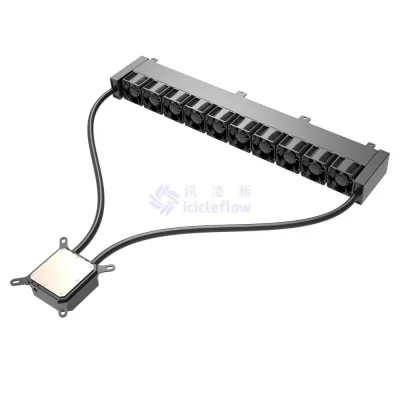
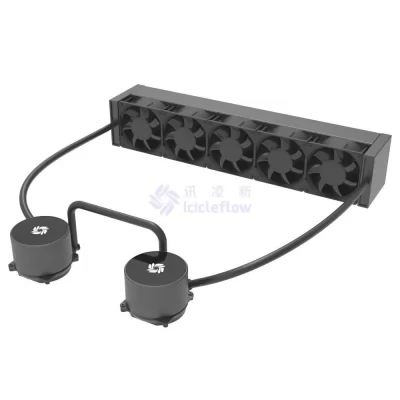
Specify a dual pump only where a single pump failure would take a revenue-generating or safety-relevant node offline; for lab, development, and most non-redundant edge racks, a single-pump unit is usually enough and halves both the failure surface and the cost. Our single-pump 1U cooler covers the majority of standard nodes, while the dual-pump 1U variant is the right spec when the second pump converts a hard outage into a scheduled service call. If your SLA treats any node loss as a ticket rather than an incident, buy the redundancy; if a node can fail over to a neighbor, do not pay for the pump you will never use.
Redundancy matters when the cost of a stopped pump is higher than the cost of the second pump plus its maintenance. In a compute cluster with spare capacity, a failed single pump takes one node out and the workload reschedules — annoying, not catastrophic. In a storage node, a medical imaging system, or a single-tenant appliance where that one box is the service, the same failure is an outage with a name on it. The decision is therefore less about the cooler and more about your failure domain: how many nodes share the load, what your SLA says, and whether a thermal shutdown mid-job is acceptable.
A useful test is to ask what happens at 3 a.m. If a pump dies and the only consequence is a rebalance, single pump is fine. If a pump dies and someone gets paged to a downed service, dual pump earns its place.
A second pump is not free, and the cost is not only the component. It adds a second failure point of its own, doubles the seal and fitting count that could leak, and complicates the loop so service takes longer. The benefit is continuity: in a properly designed redundant loop, the surviving pump holds flow while the dead one is isolated and swapped. Procurement should weigh that against the simpler, cheaper, lighter single-pump design that has one less thing to diagnose.
The mistake buyers make is treating redundancy as a default. Redundancy is insurance, and like insurance it is worth buying only against a loss you cannot absorb. Specifying dual pump on every node in a resilient cluster is paying a premium to protect capacity you already have. The other hidden cost is inventory: a dual-pump program means stocking a second pump type and its fittings, which raises sparing cost across the fleet even when every pump is healthy.
This is the parameter that decides whether redundancy is even achievable, because two small pumps do not equal one adequate pump. Your loop needs enough flow to carry the heat at your chosen coolant temperature rise — commonly 1.5–2.5 L/min per 100W of load — and enough head (pressure) to push that flow through the cold plates, hoses, and filters against their combined pressure drop. A 600W socket plate may need 8–12 L/min at a head the pump must sustain, not just reach at the nozzle.
For a redundant design, the real question is whether one pump alone can deliver the full required flow, or only half of it. True N+1 means a single pump holds the rated flow so the loop never throttles; many "dual pump" units instead run two pumps at half speed and only reach full flow if both work. Clarify which you are buying: a unit that survives on one pump at full performance, or one that merely limps. At Icicleflow we define the redundancy mode against your required flow and head during OEM qualification so the spec sheet matches the failure behavior you expect.
Dimension | Single pump | Dual pump (N+1) |
Upfront cost | Lower | Higher, roughly +40–70% on the pump assembly |
Failure surface | One pump, fewer seals | Two pumps, more fittings and leak paths |
Behavior on pump failure | Node thermal-shuts down | Survives on remaining pump (if true N+1) |
Service window | Repair during downtime | Swap live or at scheduled maintenance |
Weight and power draw | Lower | Higher |
Typical use | Dev, lab, resilient clusters | Single-tenant, SLA-bound, safety-relevant nodes |
Read the table as a map of risk, not a scoreboard. The "winner" is whichever column matches your failure domain.
Dual pump is easy to over-specify. In a hyperscale or HPC cluster where nodes are disposable and workloads reschedule, the second pump is dead weight that adds cost, weight, and two more leak paths per node across thousands of machines. It also helps little if the rest of the loop is single-points of failure — a single CDU feeding a row of "redundant" nodes still has one upstream failure that takes them all.
Consider the math at scale. A 40-node HPC rack with dual pumps adds 40 extra pump assemblies, 40 more seal sets, and 40 additional leak paths the single-pump design never introduced, while the cluster's own node-level failover already absorbs a single loss. The redundancy you paid for is redundant with the redundancy you already have. Reserve dual pump for the nodes that sit outside that safety net — the single-tenant appliance, the storage head, the edge site with no neighbor to fail over to.
Dual pump also does not substitute for good monitoring. A redundant loop with no flow or temperature alarms just fails more quietly, letting a degraded pump run until its partner is also strained. Buy redundancy only after you have addressed the larger single points in the system.
Plan for three, in order of likelihood. The first is pump wear: bearings and seals age, and a pump that runs hot or starts/stops often wears faster, so track runtime and watch for rising noise or falling flow. The second is a slow leak at a fitting or seal, which a redundant pump will happily mask by topping up pressure until the coolant reservoir runs low — so monitor reservoir level, not just pump health. The third is a full pump stall, which is exactly the case redundancy exists to absorb; confirm your loop alarms and fails over rather than letting the node cook.
None of these are exotic, and none require exotic hardware to manage. Practically, that means reading flow and reservoir level at least per rack rather than per pump, and treating a 10–15% flow drop as a warranty-event signal rather than noise. A pump rarely fails all at once; it degrades first, and that degraded phase is your window to act before redundancy is the only thing standing between you and a shutdown. They require you to decide, before purchase, which failure you cannot tolerate, and to size the pump architecture to that answer.
As an OEM/ODM liquid cooling manufacturer, we build both single and dual-pump 1U and 2U coolers, and we define the redundancy mode with you rather than defaulting to it. For redundant programs we qualify the loop at the required flow and head, confirm that a single pump sustains rated performance, and leak-test the assembled unit before shipment. Where the pump lives in a cabinet-style CDU instead of the chassis, we align the CDU pump strategy with the node strategy so the redundancy is consistent end to end. Our engineering service can model your full loop — nodes, manifolds, and CDU — so the pump decision is made once, against the real system, not per box.
Q: Can a dual pump unit keep cooling if one pump fails?
A: Yes, in a true N+1 design the surviving pump holds the rated flow so the node stays up; in some units it only reaches full flow with both pumps running. Tell us which behavior you need and we will qualify the loop accordingly before production.
Q: What flow rate and head do your pump modules deliver?
A: It is set by your loop's heat load and pressure drop, not a fixed number, and we size the pump to your required L/min and kPa during qualification. Share your cold-plate flow needs and we will match the pump stage rather than overselling a generic rating.
Q: Do you integrate the pump into the cold plate or keep it in the CDU?
A: Both are supported; chassis-mounted pumps shorten the node loop, while CDU-mounted pumps centralize service and redundancy. We recommend the layout based on whether you want redundancy per node or per rack, and can mix the two in one system.
Q: Can Icicleflow customize pump placement for a 2U or 3U chassis?
A: Yes. Through our customization service we adapt pump location, orientation, and redundancy to your mechanical envelope and service access. Send the chassis drawing and we will propose a pump architecture that fits the space you actually have.
Q: What should I specify to avoid over-buying redundancy?
A: Start from your failure domain: if a node can fail over, single pump is usually right; if a node loss is an incident, specify true N+1. Email sales@icicleflow.com with your SLA and rack topology and we will flag where redundancy pays off and where it is wasted.

Sep. 10, 2026

May. 07, 2025