Sep. 24, 2026
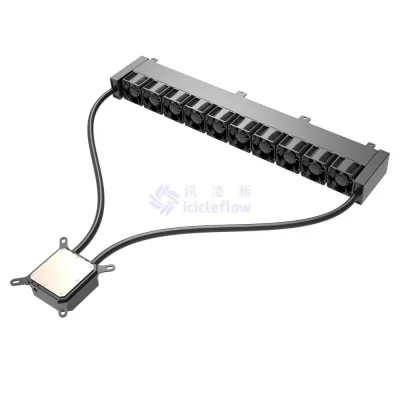
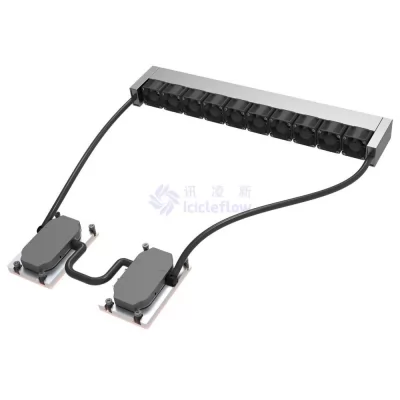
Specify a 1U server liquid cooler rated for the sustained TDP of your hottest socket, not the chip's nominal number. For most dual-socket AMD EPYC or Intel Xeon 1U nodes, that means a cold plate validated at 500–600W per socket; our 1U server liquid cooler line is built around exactly that band. If your sustained load stays under 350W per socket, a high-end air heatsink is usually sufficient and cheaper; once you cross 500W sustained, or pack an accelerator into the same chassis, liquid becomes the safer specification. Beyond roughly 600W per socket in a 1U envelope, you should step up to a 2U chassis or a direct-to-chip CDU loop rather than push the 1U plate past its thermal limit.
Air cooling still wins on simplicity for the majority of 1U compute nodes, so the first question is not "can I liquid cool it" but "do I have a problem air cannot solve cheaply." Three signals push the decision toward liquid. The first is sustained package power: a 1U chassis has roughly 40–45 mm of Z-height for the cooling stack, and above ~350W per socket most air solutions either spin fans past acceptable noise or leave no margin for turbo. The second signal is density — if you are filling the rack with high-core-count parts, the shared airflow budget runs out before any single node does. The third is accelerator co-location: a PCIe GPU or FPGA in the same 1U box adds heat the CPU cooler was never sized for.
Liquid cooling does not remove the need to manage airflow; it moves the bottleneck from the fins to the cold plate and the loop. That trade is worth it only when the air path is the constraint, not when it is merely inconvenient.
Rate the cooler against sustained load, not the vendor's "max turbo" headline. A CPU may briefly hit 400W during a boost window but average 280W under your real workload; specifying for the brief peak wastes margin and money, while specifying for the average and ignoring the peak invites throttling the day a job goes parallel. A practical rule is to size for the 95th-percentile sustained power over a representative workload, then add 15–20% headroom so the coolant temperature has room to rise on a hot aisle day.
For socket-class parts, the common bands are: under 350W per socket, air is usually enough; 350–500W, liquid starts to pay off in noise and density; 500–600W, liquid is the standard answer; above 600W, you are into direct-to-chip and CDU territory where a plain 1U cold plate is no longer the right tool. Match the rating to the socket, not to the chassis — a 1U box with two 350W sockets still needs two 350W-rated plates, not one 700W unit.
This is the parameter most buyers skip and later regret. A cold plate's TDP rating is only meaningful at the flow rate it was validated with; drop the flow and the same plate performs worse. As a working estimate, moving 600W of heat with a reasonable coolant temperature rise needs on the order of 1.5–2.5 L/min per 100W through the plate, so a 600W socket-grade plate typically wants 8–12 L/min of clean, deionized coolant delivered at a pressure drop the pump can actually sustain across the whole loop. Pressure drop scales with flow squared, so a design that looks fine at 6 L/min can double its pump load by the time it reaches 10 L/min.
The procurement implication is direct: the cold plate and the pump are one system. When you specify a 600W plate, also pin down the required flow and the allowable pressure drop, and confirm the pump module (whether in the cooler or in a rack-mounted CDU) can hold that flow after fittings, hoses, and a partly clogged filter. At Icicleflow we model flow and pressure drop against your chassis restrictions during OEM qualification rather than quoting a plate in isolation, because a plate that starves for flow fails the same way a plate that is too small does.
Form factor | Practical per-socket TDP ceiling | Typical flow per socket | Z-height for cooling stack | Where it makes sense |
1U | ~600W | 8–12 L/min | 40–45 mm | High-density compute where rack space is the constraint |
2U | ~800W+ | 10–16 L/min | 80–90 mm | Dual CPU plus accelerator, easier routing and service |
3U | 800W+ with margin | 12–18 L/min | 120 mm+ | Mixed loads, redundant pumps, test and HPC nodes |
The ceiling is not a hard wall; it is the point where margin, noise, and serviceability stop being acceptable. A 1U plate rated at 600W is doing real work at that number, whereas the same heat in 2U or 3U leaves room for a hotter coolant supply, a slower pump, or a redundant loop. If your roadmap includes a hotter next-generation socket, buy the taller chassis now rather than re-specifying the loop later.
A cold plate does not fail loudly at first. Above its rated load, the coolant outlet temperature climbs, the junction temperature follows, and the CPU or GPU begins throttling to protect itself — so you paid for silicon you cannot use. Push further and the loop runs hotter and at higher pressure, which accelerates two real risks: pump wear from sustained high head, and fitting or seal stress that raises the chance of a slow leak. None of these is immediate, which is exactly why they are dangerous; the symptom (a few percent less performance) is easy to dismiss until a node trips a thermal shutdown during a peak job.
The mitigation is boring and effective: size with headroom, monitor coolant temperature at the inlet and outlet, and treat a rising outlet temperature as a capacity alarm, not a sensor glitch.
Liquid cooling is not automatically the right answer. For nodes that sit under 300W per socket, run in a cool, well-aired room, and are serviced by general IT staff, a good air heatsink avoids a loop, a pump, and a coolant path that someone has to maintain. Liquid also adds a failure domain — a leak, however unlikely, is a problem air simply does not have. And for very low-volume or lab-only boxes, the engineering and qualification cost of a custom 1U plate can outweigh the density gain.
Use liquid where density, noise, or sustained high load make air the limiting factor. Use air where the workload is modest and uptime depends more on simplicity than on watts per rack unit.
As an OEM/ODM liquid cooling manufacturer, we treat the TDP number as a system spec, not a sticker. For 1U, 2U, and 3U cold-plate programs, we qualify each design against your socket footprint, sustained load, and chassis flow path, then confirm it on a flow bench that records inlet/outlet temperature and pressure drop at the rated flow. Plates and pump modules leave with a leak test on the assembled loop, and custom geometries are supported through our customization service when your socket or mechanical envelope is not a standard one. If you are still deciding between air and liquid, our engineering team can model the loop with your real workload rather than a generic number.
Q: Can Icicleflow build a 1U cold plate for a socket hotter than 600W?
A: Yes, for accelerator and next-gen CPU packages we design plates beyond the standard 600W band, but above that point we usually recommend a 2U or direct-to-chip CDU path for serviceability. Send your package footprint and sustained load to sales@icicleflow.com and we will confirm the right form factor before tooling.
Q: What flow rate does your 1U cooler need per socket?
A: It depends on the rated TDP and your allowable coolant temperature rise, typically in the 8–12 L/min range for a 600W socket plate. We specify the exact flow and pressure drop during qualification so the pump you pair with it is not undersized.
Q: Do you leak-test the loop before shipping?
A: Yes. Every assembled pump-and-plate loop is pressure-leak tested before it leaves, and we can supply the test record with the batch. For volume programs we keep the test procedure documented so your incoming inspection can repeat it.
Q: Is a single-pump or dual-pump 1U cooler better for my rack?
A: It depends on what a pump failure costs you; we cover that decision in our guide on single vs dual pump redundancy. For most non-redundant edge and dev racks a single pump is enough, while revenue-critical nodes often justify the second pump.
Q: What is the minimum order quantity for a custom 1U liquid cooler?
A: We support both prototyping and volume production, and the MOQ depends on whether the plate is a standard geometry or a fully custom one. Contact sales@icicleflow.com with your drawing or socket model and we will quote both the prototype and production quantities.

Sep. 10, 2026

May. 07, 2025